
- Only about 0.6% of websites are in Arabic, while Google handles 93–94% of searches in Saudi Arabia and the UAE. Good Arabic pages stand out quickly.
- Work in order: Arabic keywords, then structure and hreflang, then category pages, product pages, technical RTL, links and measuring.
- Category pages are your biggest SEO asset. Give each one an Arabic H1 with the searched noun, a short MSA intro, sub-category links and an Arabic FAQ.
- Build links inside each Gulf country: original data for regional business press, and licensed creators for brand searches.
- Judge results after 90 days in Search Console, filtered by country and query.
Arabic ecommerce SEO is about one thing: being the best Arabic answer when a Gulf shopper searches on Google. Right now, that's easier than it sounds.
Hundreds of millions of people speak Arabic, but only a tiny slice of the web is written in it. Many Arabic shopping searches still show thin category pages and rough machine translations.
Here's the order to work in on any platform, plus Arabic category-page copy patterns, Gulf link-building ideas, a 90-day plan and a worked category brief.
Why is Arabic search so under-served?
Because demand grew faster than content. Gulf shoppers search in Arabic every day, yet few stores publish real Arabic pages built around those searches.
That gap helps you in three ways:
- One engine to win. Google handles almost every search in Saudi Arabia and the UAE, so one strategy covers nearly everyone.
- Weak results to beat. Many Arabic shopping queries return marketplace listings, thin categories and translated copy. A well-written Arabic page stands out fast.
- Google can't fill the gap well. When Arabic pages are scarce, Google may show an auto-translated copy of an English page. You can't edit that copy, so a native Arabic page is the version you want ranking.
So where do you start? With the right order.
The order to do Arabic SEO in
Each step builds on the one before. Skip keyword research and your category pages target the wrong words. Skip structure and Google may never index your Arabic pages.
- 1
Arabic keyword research
Find the words Gulf shoppers actually type, per country and per dialect.
- 2
Site structure and hreflang
One language per URL, linked with valid codes like ar-SA and en-AE.
- 3
Category pages
Arabic H1s, short intros, sub-category links and FAQs.
- 4
Product pages
Searched nouns in titles, full Arabic specs, local trust details.
- 5
Technical RTL SEO
lang and dir tags, fast Arabic fonts, Western digits, no forced redirects.
- 6
Content and links
Buying guides that link to categories, and links from Gulf sites.
- 7
Measuring
Search Console by country and query, plus Arabic conversion rates.
1. Arabic keyword research
Don't translate your English keyword list. The word a Gulf shopper types is often not the one a translator picks, and it changes from country to country. Build a map of Arabic terms per country before you write a single page, using our Arabic keyword research guide.
2. Site structure and hreflang
Give each language its own URL, such as /ar-sa/ and /en-ae/. Then connect the versions with hreflang tags so Google shows the right one in each country. Our hreflang guide for Gulf stores covers the codes and the common mistakes.
3. Category pages
Arabic shopping searches mostly land on category results, so these pages carry most of your SEO weight. Each one needs a clear Arabic H1, short copy and links to its sub-categories. For Saudi head terms and seasonal category ideas, see ecommerce SEO in Saudi Arabia.
4. Product pages
Start each title with the noun shoppers search, then brand, key attribute and size. Translate everything that helps someone buy: specs, size guide, delivery and returns. Saudi shoppers also look for VAT-inclusive prices, payment badges and Arabic reviews, all covered in what Saudi shoppers expect on a product page.
5. Technical RTL SEO
Every Arabic page needs lang="ar" and dir="rtl", one self-hosted Arabic font family and Western digits in prices. Heavy Arabic fonts are a common cause of slow mobile pages. Run through the RTL QA checklist before launch.
6. Content and links
Write Arabic buying guides that answer real questions, then link each one to its category page. Links from sites in each target country matter too, because authority doesn't transfer evenly across markets. Licensed creators are one of the fastest ways to earn brand searches, so start with our influencer marketing guide.
7. Measuring
Search Console is your main scoreboard. Filter the Performance report by country, then by query, and track Arabic terms separately from English ones. Our bilingual SEO guide shows how to set up one property per locale.
On Shopify? Our Shopify Arabic SEO guide walks through each of these steps inside the admin.
Arabic category-page copy patterns
A good Arabic category page reads like a helpful shop assistant, not a keyword list. Use clear, simple MSA (Modern Standard Arabic) for the body, and keep light dialect for banners and buttons.
Here's a pattern for each block:
| Block | Pattern | Arabic example |
|---|---|---|
| H1 | Searched plural noun + audience or type | شنط نسائية |
| Meta title | H1 + main benefit + brand | شنط نسائية بأسعار شاملة الضريبة | اسم المتجر |
| Line above the grid | One sentence: range + delivery or payment | تشكيلة شنط يد وكروس وظهر، مع توصيل سريع ودفع عند الاستلام. |
| Sub-category links | Descriptive Arabic anchors, not "المزيد" | شنط كروس · شنط يد · شنط ظهر |
| Buying guide below the grid | 2–3 short H2s that answer how to choose | كيف تختارين مقاس الشنطة المناسب؟ |
| FAQ | Real questions, including dialect forms | وش أفضل شنطة للدوام؟ |
| Trust line | Delivery by city + returns window | الرياض وجدة: توصيل خلال 1–2 يوم |
A few rules make the difference:
- Match the reader's gender. Gulf fashion and beauty stores address women's categories with feminine verbs such as تسوّقي and اختاري. For men's or mixed categories, use the standard masculine form (تسوّق) or a noun phrase like تسوّق الآن. A mismatched gender is one of the quickest machine-translation tells.
- Use the searched word in the H1, the formal variant in the body. Saudis search شنطة and شنط, so one of them goes in the H1, and حقيبة appears naturally in the guide.
- Keep the intro short. Shoppers on phones want products first, so the long copy belongs below the grid.
- Use Arabic punctuation (، ؟). Skip the decorative stretch character (ـ) in titles and headings, because a stretched word no longer matches what shoppers type.
Worked example: an Arabic category page brief
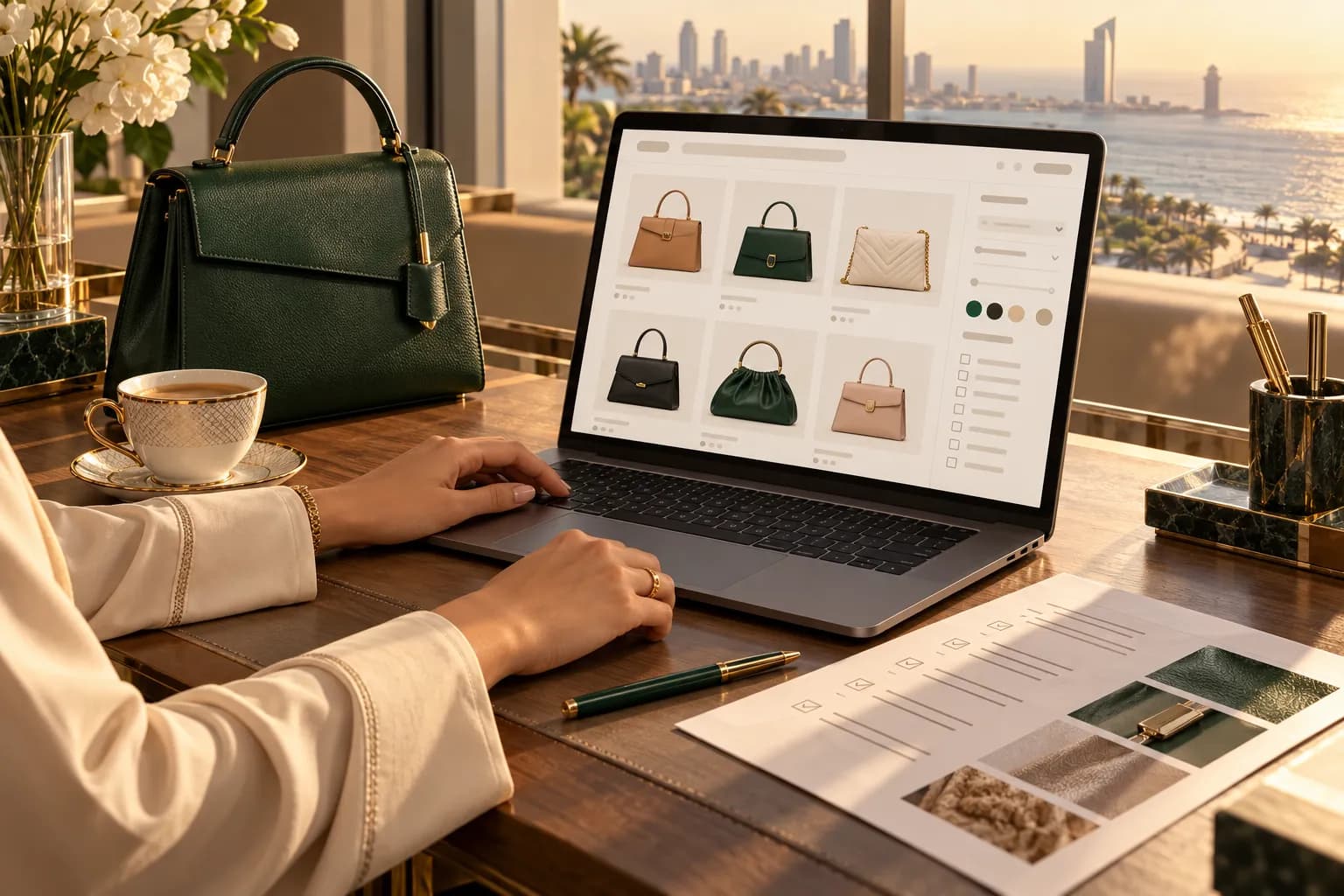
Let's brief one real page: women's bags for a Saudi store. In Google Trends, Saudis search شنطة more than four times as often as the formal حقيبة, and the plural شنط is close behind شنطة. So the brief targets the plural people use for a whole range.
| Brief field | What goes in |
|---|---|
| URL | /ar-sa/collections/women-bags (English handle, used consistently) |
| Primary keyword | شنط نسائية |
| Variants to use in the body | شنطة نسائية، حقيبة نسائية، شنطة يد |
| H1 | شنط نسائية |
| Meta description | تسوّقي شنط نسائية للدوام والمناسبات بأسعار شاملة الضريبة، مع توصيل سريع ودفع عند الاستلام. |
| Above the grid | One line: range, delivery and payment options |
| Sub-category links | شنط كروس، شنط يد، شنط ظهر، شنط سهرة |
| Below the grid | Guide: choosing a size, materials for summer heat, bags for gatherings (المناسبات) |
| FAQ ideas | وش أفضل شنطة للدوام؟ هل الشنطة الجلد تتحمل الحر؟ كم مدة التوصيل للرياض؟ |
| Internal links | From the homepage, the main menu and two buying-guide posts |
| hreflang pair | en-sa version of the same collection |
Notice what's missing. There's no long block of keywords and no copy pasted from the English page.
The writer gets one primary term, a few natural variants and real questions to answer. That's enough for a page that ranks and converts.
Arabic link building and PR in the Gulf
Links still count, and they count most when they come from your target country. An Arabic page for Saudi shoppers gains more from Saudi sites than from a random English blog.
Three options work well here:
- Publish data the press wants. Regional business media such as Khaleej Times and Zawya regularly cover ecommerce studies from Gulf companies. Your own sales trends by city or season can earn the same kind of coverage.
- Work with licensed creators. Snapchat reaches about 73% of people in Saudi Arabia, and creators there act like trusted friends. Paid posts need a Mawthooq licence in the Kingdom and the UAE Advertiser Permit in the Emirates, so check both before you sign.
- Make a page worth citing. An Arabic size guide, care guide or price comparison earns links on its own merit. Original tables, like a dialect comparison, are exactly what writers link to.
Bottom line? Pick one option per quarter and do it properly.
Your first 90 days
Here's a realistic plan for a store starting Arabic SEO from scratch.
- Days 1–14Research and structure
Build the Arabic keyword map per country. Set up Arabic URLs, hreflang and one sitemap per language in Search Console.
- Days 15–30First category pages
Brief and write your top 5–10 Arabic category pages, using the copy patterns above. Fix technical RTL issues.
- Days 31–60Product pages
Rewrite titles and specs for your best-selling products in Arabic. Add Arabic reviews and delivery details.
- Days 61–75Content and outreach
Publish two Arabic buying guides linked to categories. Start one link or PR project.
- Days 76–90Measure and expand
Check Arabic queries by country in Search Console. Add pages for the terms already gaining impressions.
By day 90, you should see impressions growing on Arabic long-tail terms. That's your signal to add more categories.
Notes for marketplace sellers
- Amazon.sa and noon rank in Arabic Google too, but you control only the listing, not the page structure.
- Fill the Arabic title and bullets yourself rather than relying on auto-translation.
- Use marketplace search suggestions in Arabic as a keyword source for your own store. For listing titles that rank inside noon, see noon product listing optimization.
Notes for UAE-first stores
- English-first works in the UAE, but Arabic pages reach Emiratis, Arab expats and Arabic ads.
- Give the UAE its own /ar-ae/ version when currency, VAT, delivery promises or range differ from Saudi, as they do for most stores.
- Keep brand and model names in Latin script in Arabic titles, because UAE shoppers often type them that way. More in Arabic vs English for UAE stores.
Frequently asked questions
The strategy is the same everywhere: research Arabic terms, give each language its own URL, and write real Arabic category and product pages. What changes is the setup. Shopify writes hreflang for you through Markets, while on other platforms you may need an app or a developer. Check the page source on any platform before you trust it.
Sources & further reading
- Search engine market share, Saudi Arabia (Sep 2026) — StatCounter Global Stats
- Search engine market share, UAE (Sep 2026) — StatCounter Global Stats
- Usage statistics of content languages for websites — W3Techs
- Managing multi-regional and multilingual sites — Google Search Central
- International SEO best practices — Ahrefs
- Google Trends 12-month comparisons of Arabic product terms (pulled 26 Oct 2026) — Google Trends
- Digital 2026: Saudi Arabia — DataReportal
This guide is for general information only and is not legal, tax or financial advice. Rules and fees change — always confirm with the official source or a licensed advisor.

Maya is MiddleEastEcom's lead guide and editor. She researches GCC marketplaces, payments and regulations and turns them into practical playbooks for sellers.
Meet Maya