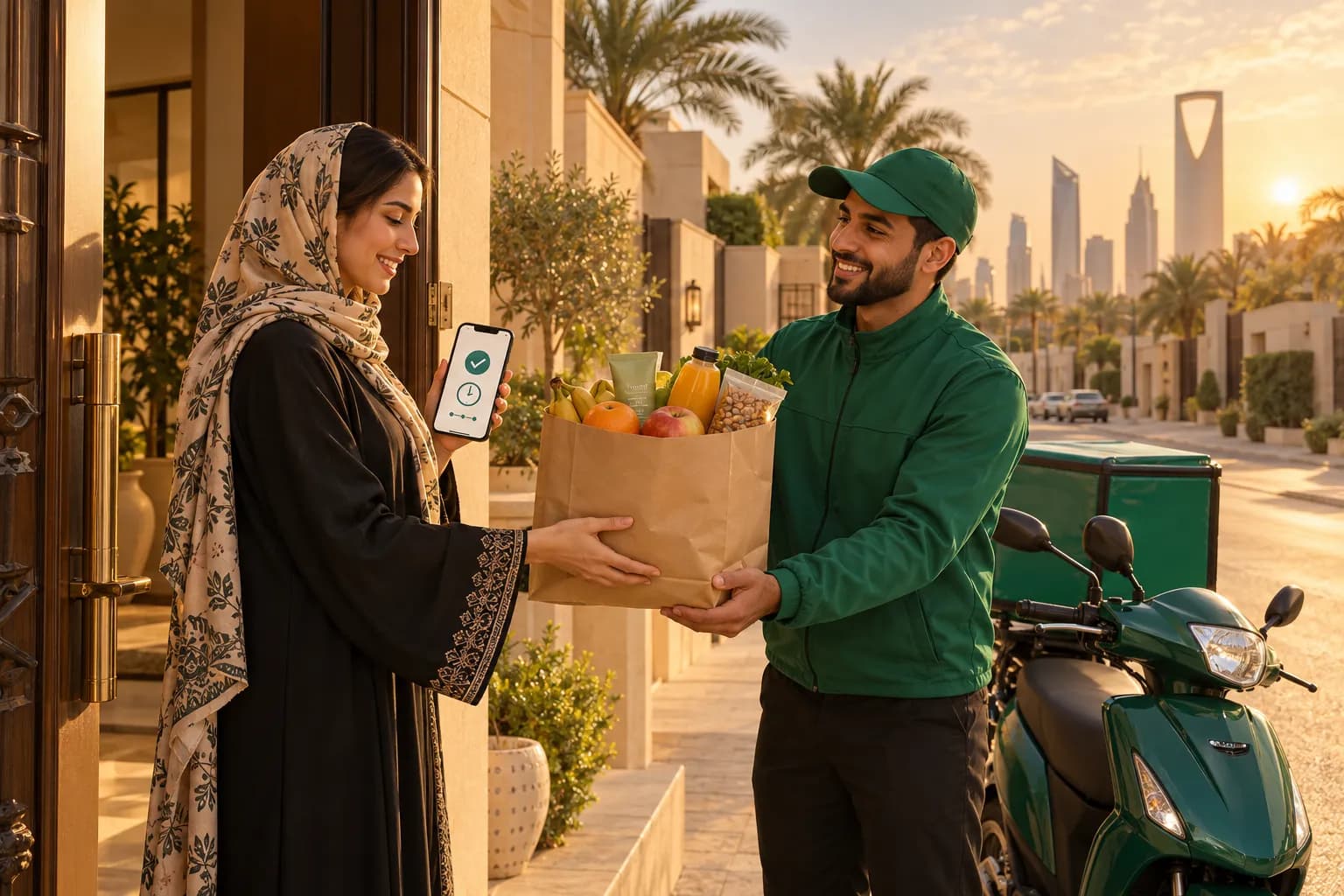

- Quick commerce means delivery in 15–30 minutes from dark stores, small warehouses built only for online orders.
- talabat mart leads in the UAE and the smaller Gulf states. Ninja and noon Minutes lead in Saudi Arabia.
- Most apps buy your stock (1P), so you get in through their category buyers or a distributor. Shops can also list on talabat, InstaShop, Jahez or HungerStation.
- Plan for the platform to keep 25–45% of the shelf price, plus promotions and ads. Price your range with that in mind from day one.
- Groceries, snacks, drinks, beauty, personal care, baby and pharmacy products sell best.
Gulf shoppers no longer plan the weekly shop. They tap an app and their shampoo, snacks or baby wipes arrive in 15 minutes.
That habit is growing fast, and it's a big chance for brands. Every dark store needs a full shelf of products, and the apps are hungry for new ones.
Getting in works differently from Amazon or noon. You don't upload a listing; you sell your stock to the app, or to a distributor who supplies it.
You'll see which apps lead in each country, the two routes in, what the numbers look like and how to land your first listing.
What is quick commerce?
Quick commerce (q-commerce) is online shopping delivered in under an hour, usually 15–30 minutes. It covers the things people need right now: groceries, drinks, snacks, toiletries, beauty, baby care and medicine.
The speed comes from dark stores. A dark store is a small warehouse in a residential area, closed to the public and built only to pick online orders. Riders wait outside, so an order can leave a couple of minutes after the shopper pays.
That changes what a "listing" means:
- Space is tight. A dark store holds a few thousand products, not millions. Every slot has to earn its place.
- The app picks the range. Category buyers decide what goes on the shelves, much like a supermarket.
- Speed sells impulse buys. Shoppers add chocolate, a face mask or a phone cable to their basket because it arrives with the milk.
So think of quick commerce as a supermarket that lives inside a phone. You win by getting on the shelf and staying there.
Which quick commerce apps lead in the GCC?
Each country has its own leaders. Talabat dominates the UAE and the smaller Gulf states, while Saudi Arabia has its own home-grown players.
| Countries | Model | Delivery promise | How brands get in | |
|---|---|---|---|---|
| talabat mart | UAE, Kuwait, Qatar, Bahrain, Oman | Own dark stores + 9,500+ listed local shops | About 20 min | Supply talabat's buyers, or list your shop |
| noon Minutes | Saudi Arabia, UAE | Own dark stores; also inside the Jahez app in Saudi | 15 min | Supply noon's grocery buying team |
| Ninja | Saudi Arabia (+ Bahrain, Kuwait, Qatar) | Own dark stores | Under an hour | Supply Ninja's buyers, often via a distributor |
| InstaShop | UAE and other talabat markets | Marketplace of local supermarkets and pharmacies (owned by talabat) | Under an hour | List your shop, or get stocked by listed shops |
| Careem Quik | UAE (Dubai, Abu Dhabi) | Own dark stores inside the Careem app, 12,000+ products | 15 min | Supply Careem's buyers |
| HungerStation | Saudi Arabia | Food app with HungerStation Mart dark stores + shop listings | Under an hour | Supply the Mart, or list your shop |
| Jahez | Saudi Arabia, Kuwait, Bahrain | Food app with shop listings; hosts noon Minutes | Under an hour | List your shop (Zid connects to Jahez) |
| Snoonu | Qatar (launching in Kuwait and Bahrain) | Super app: food, grocery, retail | Under an hour | List your shop or supply its stores |
| Nana | Saudi Arabia | Grocery and beauty; in court reorganisation since Apr 2026 | About 20 min | Supply on short terms only |
A few things stand out:
- Talabat is not in Saudi Arabia. In the Kingdom, the big dark-store networks are Ninja and noon Minutes.
- The market is consolidating. Jahez is buying Snoonu, talabat owns InstaShop, and noon Minutes sits inside the Jahez app. Fewer, bigger buyers means one deal can reach more shoppers.
- Some players stepped back. Careem pulled out of Saudi grocery delivery but still runs Quik in the UAE. Nana is restructuring. Stick with the leaders for your first listings.
Want to see how quick commerce fits with Amazon and noon? Read our comparison of the best marketplaces in the Middle East.
How do brands get listed? The two routes in
There are two ways onto these apps. Which one you use depends on whether you run a shop in the Gulf or supply products to shops.
Route 1: supply the dark stores (1P)
This is how most brands get in. "1P" (first party) means the app buys your stock and sells it as its own, like a supermarket does.
You can reach the app's buyers in two ways:
- Through a distributor. A GCC distributor that already supplies talabat mart, Ninja or noon Minutes adds your products to its range. It handles orders, invoicing, delivery into the warehouse and payment collection. This is the fastest route for foreign brands.
- Direct to the category buyer. You pitch the app's grocery or beauty buying team yourself. You need a local entity (or importer of record), registered products and the capacity to deliver into their warehouses on time.
None of the big apps publishes a public supplier sign-up form. The buyers find brands through distributors, trade events and direct emails to their category teams.
Route 2: list your shop (marketplace)
If you already run a pharmacy, beauty store, bakery or mini-market, you can list it as a shop. Talabat lists more than 9,500 local shops this way, and InstaShop, Jahez, HungerStation and Snoonu work the same way.
You keep your own stock, the app sends you orders, and its riders collect from your counter. You pay a commission on each order instead of selling at a wholesale price.
Selling on Zid in Saudi Arabia? Its connector pushes your catalogue to Jahez, so your online store and delivery-app shop share one inventory. See our Zid guide.
What sells best on quick commerce?
Quick commerce rewards small, fast-moving items people need today. The best categories are:
- Grocery staples and fresh food. Milk, bread, eggs, fruit, water. The apps sell these at thin margins to win the habit.
- Snacks, drinks and treats. Chocolate, chips, energy drinks and coffee. These are the impulse add-ons that lift basket size.
- Beauty and personal care. Skincare, haircare, deodorant, fragrance minis and razors. Strong margins and easy to stock.
- Baby and household. Nappies, wipes, formula, cleaning products.
- Pharmacy and wellness. Pain relief, vitamins and first aid, where rules allow.
- Small electronics. Phone chargers, cables, earphones and batteries.
Talabat's results show how far beyond food this has gone. In Q4 2025, 32% of its sales were grocery and retail, not restaurant meals.
Big, heavy or slow-selling products struggle. If it doesn't fit in a rider's bag or sell weekly in every neighbourhood, a marketplace like noon with its own fulfilment is a better home.
How to get your products into quick commerce, step by step
Most brands follow the same path. Allow one to three months from first meeting to first delivery.
- 1
Pick your hero products
Choose 3–10 fast sellers with long shelf life and a clear price point. Quick commerce buyers list proven products, not full catalogues.
- 2
Register and label them
Food, cosmetics and supplements need SFDA registration in Saudi Arabia or municipality registration in the UAE. Add Arabic labels and a GTIN barcode on every unit.
- 3
Choose your route in
Sign with a distributor that already supplies your target apps, or set up a local entity or importer of record to supply them directly.
- 4
Pitch the category buyer
Send a one-page pitch: products, shelf prices, margins offered, sales proof elsewhere and a launch promotion plan.
- 5
Agree the terms in writing
Margin, payment days, launch fees, promotion calendar, ad spend and the rules for returns and expired stock.
- 6
Deliver into the warehouse
Most apps take stock at a central warehouse and spread it across dark stores. Book slots and hit them: missed deliveries cost you shelf space.
- 7
Track sell-through and push
Check weekly sales per dark store, fix stock-outs fast and fund sponsored listings during Ramadan and big sale weeks.
Registration is the step that slows most brands down, so start it first. Our guides to SFDA rules for cosmetics and food and GCC product labelling walk you through both.
What does quick commerce cost? Margins, fees and payment terms
Terms are negotiated brand by brand. Distributors and sellers report a consistent picture for the supply (1P) model:
- Platform margin. The app buys your product at 25–45% below the shelf price (excluding VAT). Staples sit at the low end, beauty and personal care at the high end.
- Distributor margin. If a distributor supplies the app for you, it keeps 15–35% of the price the app pays it, depending on how much it does.
- Launch and listing fees. Many buyers ask for a one-off fee or free stock to open new products.
- Promotions and ads. Plan 5–10% of sales for discounts, plus sponsored listings inside the app. Sellers report ad spend of 8–15% of online sales in competitive categories.
- Payment terms. Expect to be paid 60–90 days after delivery, sometimes longer.
In the marketplace model (route 2), it's simpler: you pay a commission per order, typically 12–25% depending on the app and category.
Worked example: a skincare serum in Dubai
Let's run the numbers for a UAE skincare brand selling a serum at AED 60 on talabat mart, through a distributor, on typical terms.
Source: MiddleEastEcom worked example on seller-reported terms. Shelf price AED 60 including 5% VAT.
Here's how it works:
- Remove VAT. The shelf price includes UAE VAT. Take it off and the net price is AED 57.14.
- The app's margin. At 40%, talabat buys the serum for AED 34.29.
- The distributor's margin. It keeps 25% of the app's price, so it buys from you at AED 25.71.
- Promotions. You fund 8% of the net shelf price in discounts and ads, which is AED 4.57 a unit.
- Your profit. Take off your landed product cost of AED 12 and you keep AED 9.14 a unit.
Now scale it. Say the serum sits in 40 dark stores and each sells three a week. That's about 520 units a month, or roughly AED 4,750 profit a month.
The real prize is what comes next. Once the serum proves itself, the buyer adds your next products and gives you better slots. Supplying the app directly later also hands the distributor's AED 8.57 back to you, minus your own warehousing and delivery.
Want to check your own product? Run the same steps with your shelf price, then talk to distributors and 3PLs through our free quote service.
How dark-store logistics work for suppliers
You rarely deliver to each dark store yourself. Most apps take stock into one central warehouse per city, then spread it to their dark stores overnight.
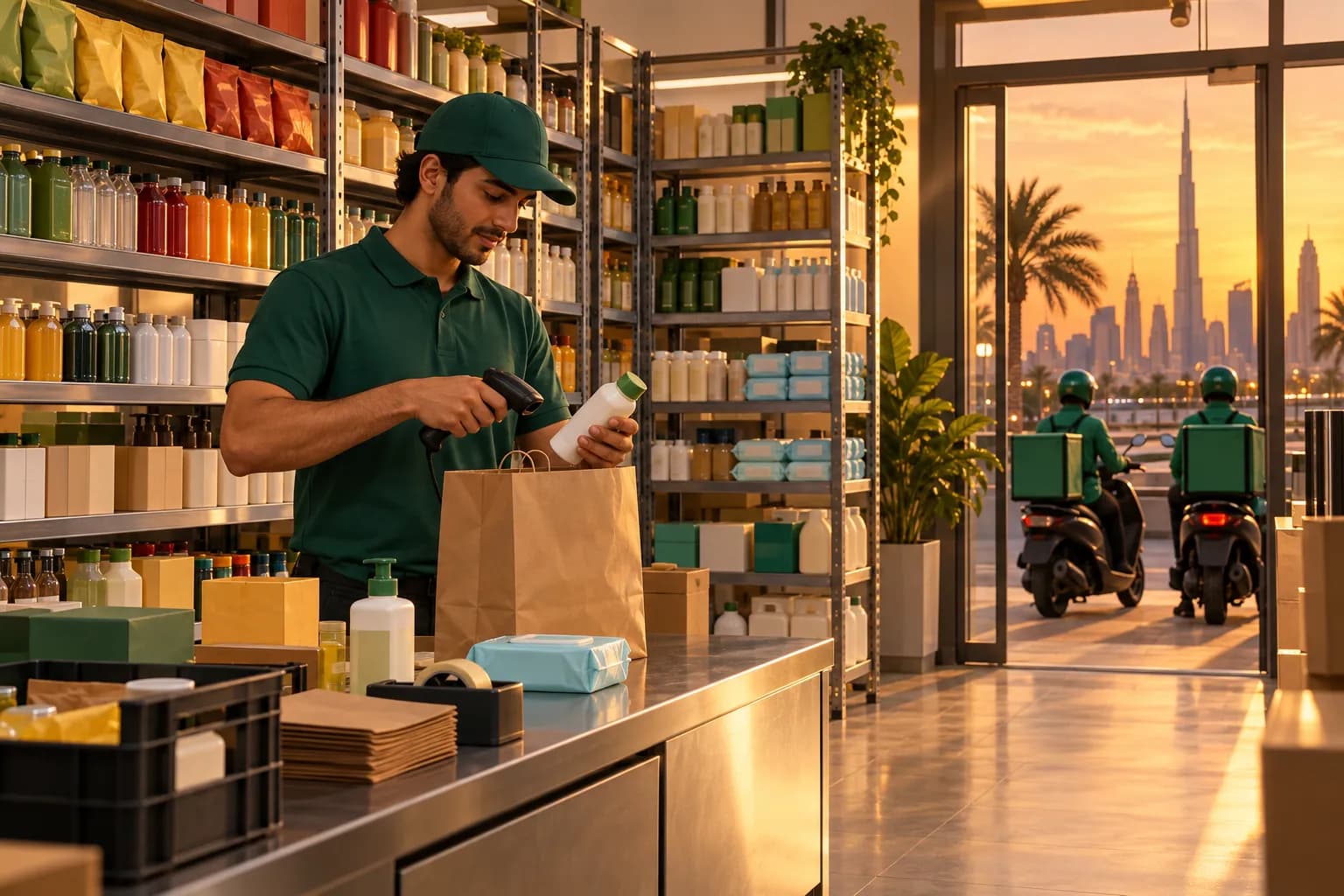
What buyers expect from you:
- Reliable fill rates. Deliver the full order, on the booked day. Repeated shortfalls are the fastest way to lose your slot.
- Fresh dates. Buyers usually reject short-dated stock. Aim for at least 75% of shelf life left on arrival.
- Retail-ready packs. Barcoded units in cartons the warehouse can split without repacking.
- Fast restocks. Small, frequent deliveries beat one big drop. A local warehouse or 3PL makes this much easier.
That's why most foreign brands hold stock in a Gulf warehouse before they pitch. Compare options in our warehousing provider directory.
Why now is a good time to get in
Quick commerce is moving from a nice extra to the everyday way Gulf families shop. And growth hasn't slowed.
Saudi shoppers placed 118 million orders through delivery apps in the first quarter of 2026. That's up 49% on a year earlier.
The money behind it is serious. Ninja reached a USD 1.5 billion valuation in 2025 and is lining up a Riyadh stock market listing. Talabat is putting more than USD 100 million into talabat mart this year.
Every new dark store is a new shelf to fill. Brands that get listed during this build-out lock in the best slots before categories fill up.
Notes for Saudi brands
- Your main targets are Ninja and noon Minutes, with HungerStation and Jahez for shop listings.
- A noon Minutes listing in Saudi Arabia also shows inside the Jahez app, so one deal reaches two audiences.
- Price for 15% VAT and get SFDA registration done before you pitch. Buyers won't list unregistered food or cosmetics.
Notes for UAE brands
- Talabat mart and noon Minutes are the two leaders, with Careem Quik and InstaShop close behind.
- Food products need municipality registration, such as Dubai Municipality's Montaji system.
- Homegrown UAE brands often get a warmer welcome. Talabat has run programmes to bring local FMCG start-ups onto talabat mart.
Notes for Qatar, Kuwait, Bahrain and Oman
- Talabat is the dominant app in all four markets, so one talabat mart deal can cover most of the smaller Gulf.
- In Qatar, add Snoonu. In Kuwait and Bahrain, watch Snoonu's launch and Ninja's expansion.
- Read our guide to ecommerce rules in Qatar, Kuwait, Bahrain and Oman before you ship.
Notes for foreign and Chinese brands
- You need a local party the app can invoice and pay. A distributor or an importer of record solves this without opening a Gulf company.
- Start in one country, usually the UAE, then use your sales data to pitch Saudi buyers.
- Products sold on Amazon or noon give you proof to show buyers. Lead with your best-selling items and real sales numbers.
- Explore more channels beyond the big two in our hub for other Gulf marketplaces.
Frequently asked questions
Not in the dark stores themselves. Talabat mart buys its own stock from brands and distributors. If you run a physical shop in a talabat country, you can list that shop on talabat instead and fulfil orders from your own shelves.
Sources & further reading
- Talabat posts 28% GMV growth in 2025, sets $100m for expansion — TradeArabia
- Saudi delivery sector tops 124 mn orders in Q4 2025 — Mubasher (Transport General Authority data)
- Ninja raises $254 million at a $1.5 billion valuation — MENAbytes
- Jahez and noon join forces on quick commerce and food delivery — TechAfrica News
- Jahez to acquire Snoonu — Argaam
- Nana: from market pioneer to the courtroom — Saudi FoodTech
- Everything you can get in 15 minutes with Careem Quik — Time Out Dubai
- Quick retail surges: Ninja leads in KSA, talabat and noon share the lead in UAE — Redseer
This guide is for general information only and is not legal, tax or financial advice. Rules and fees change — always confirm with the official source or a licensed advisor.

Maya is MiddleEastEcom's lead guide and editor. She researches GCC marketplaces, payments and regulations and turns them into practical playbooks for sellers.
Meet Maya