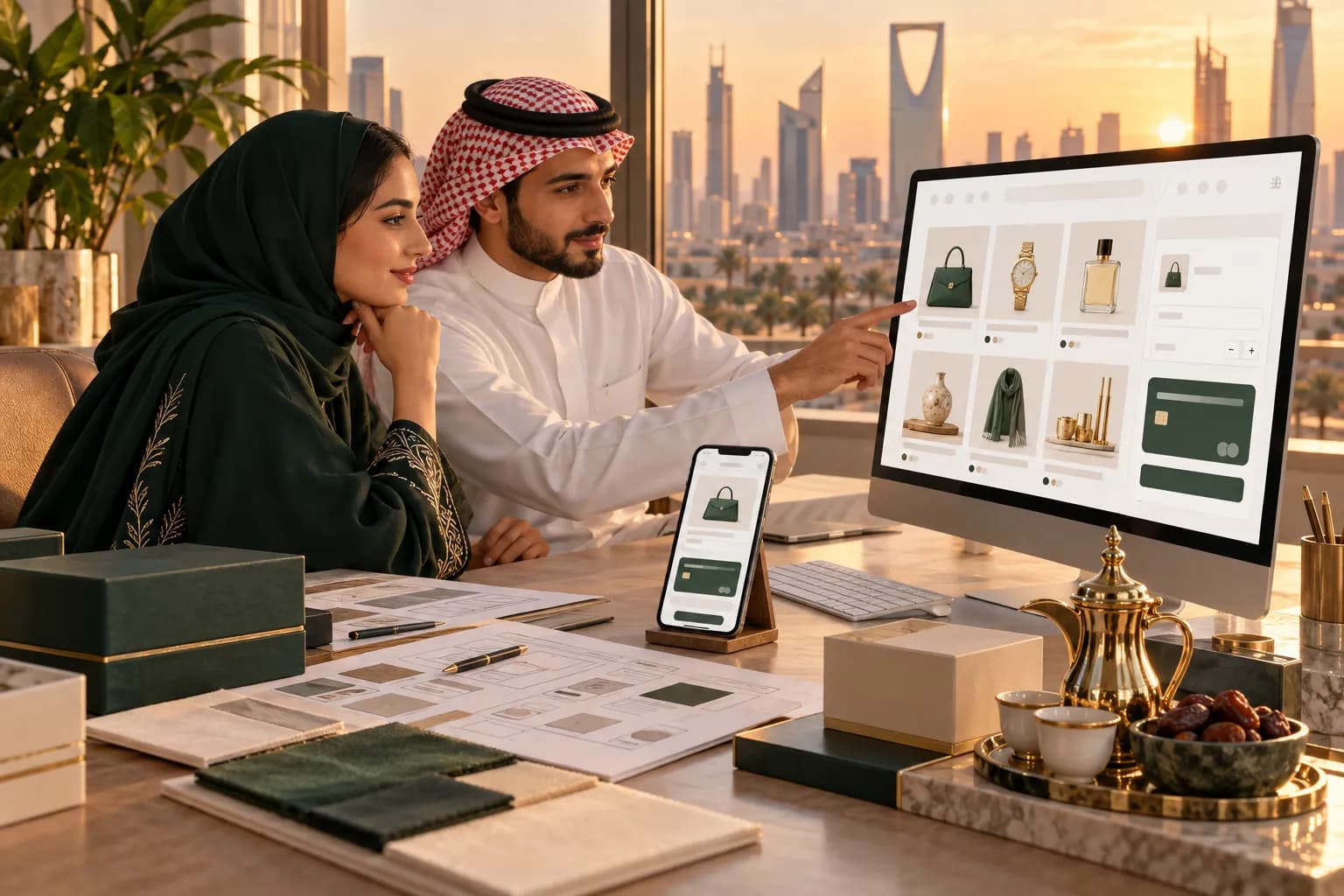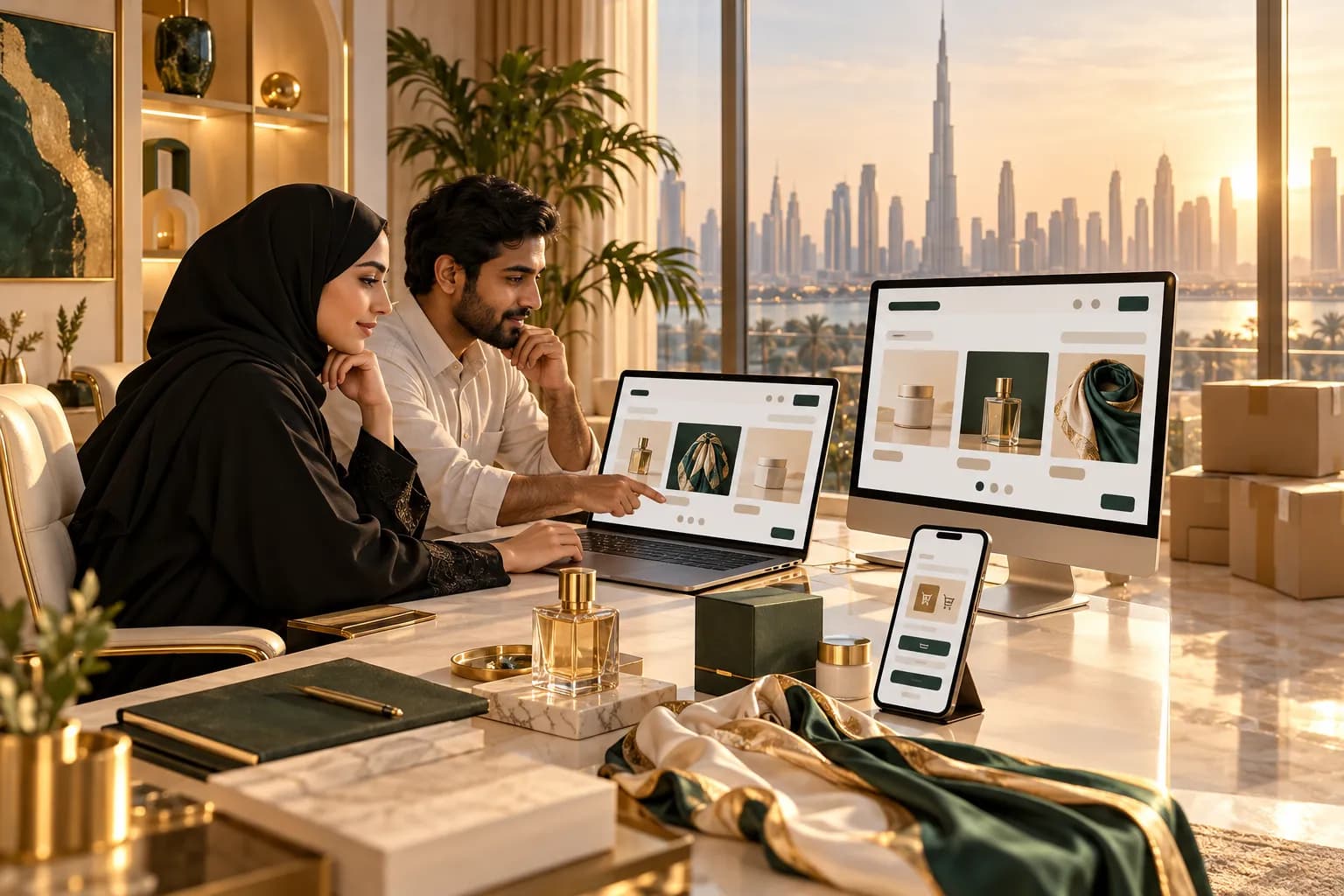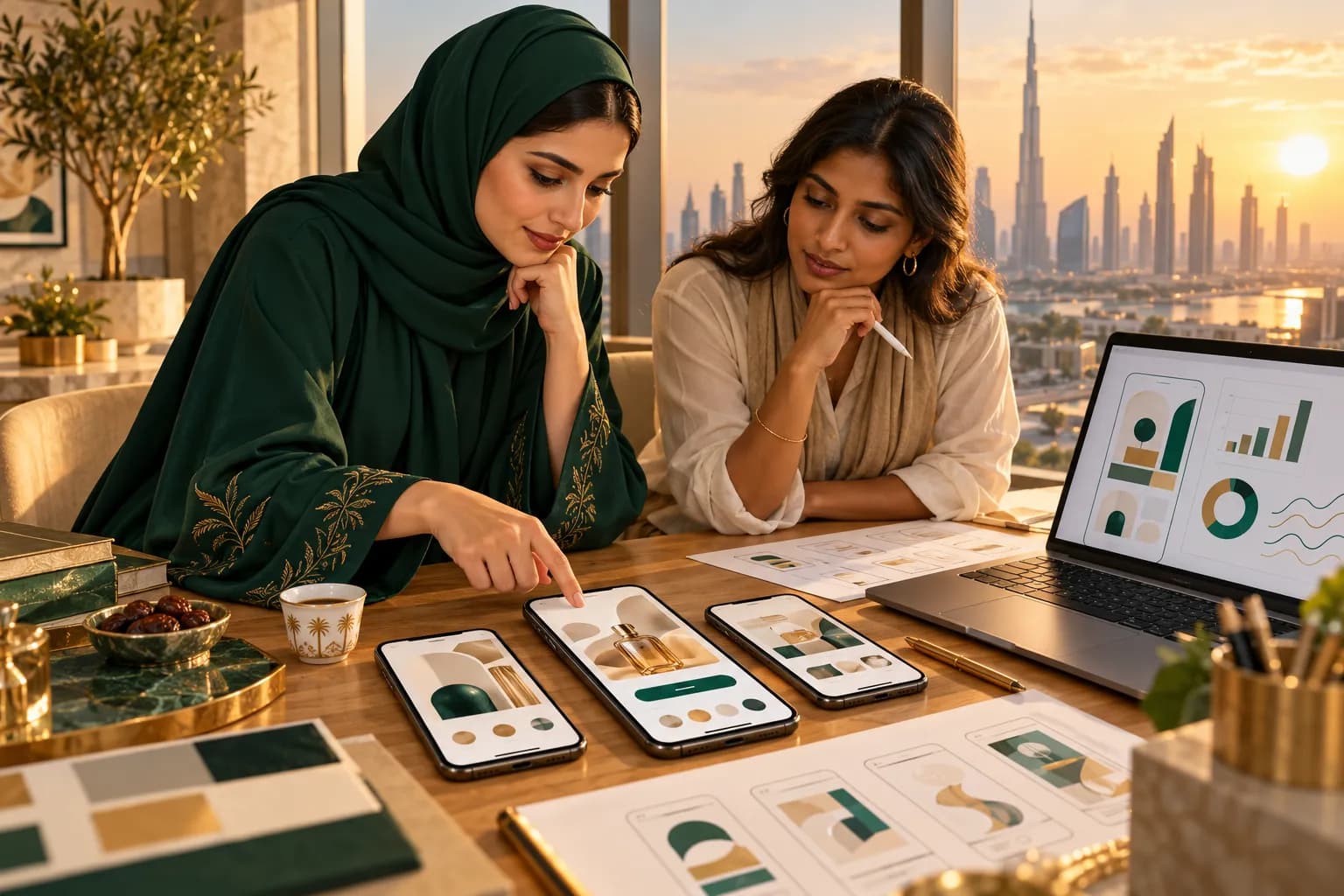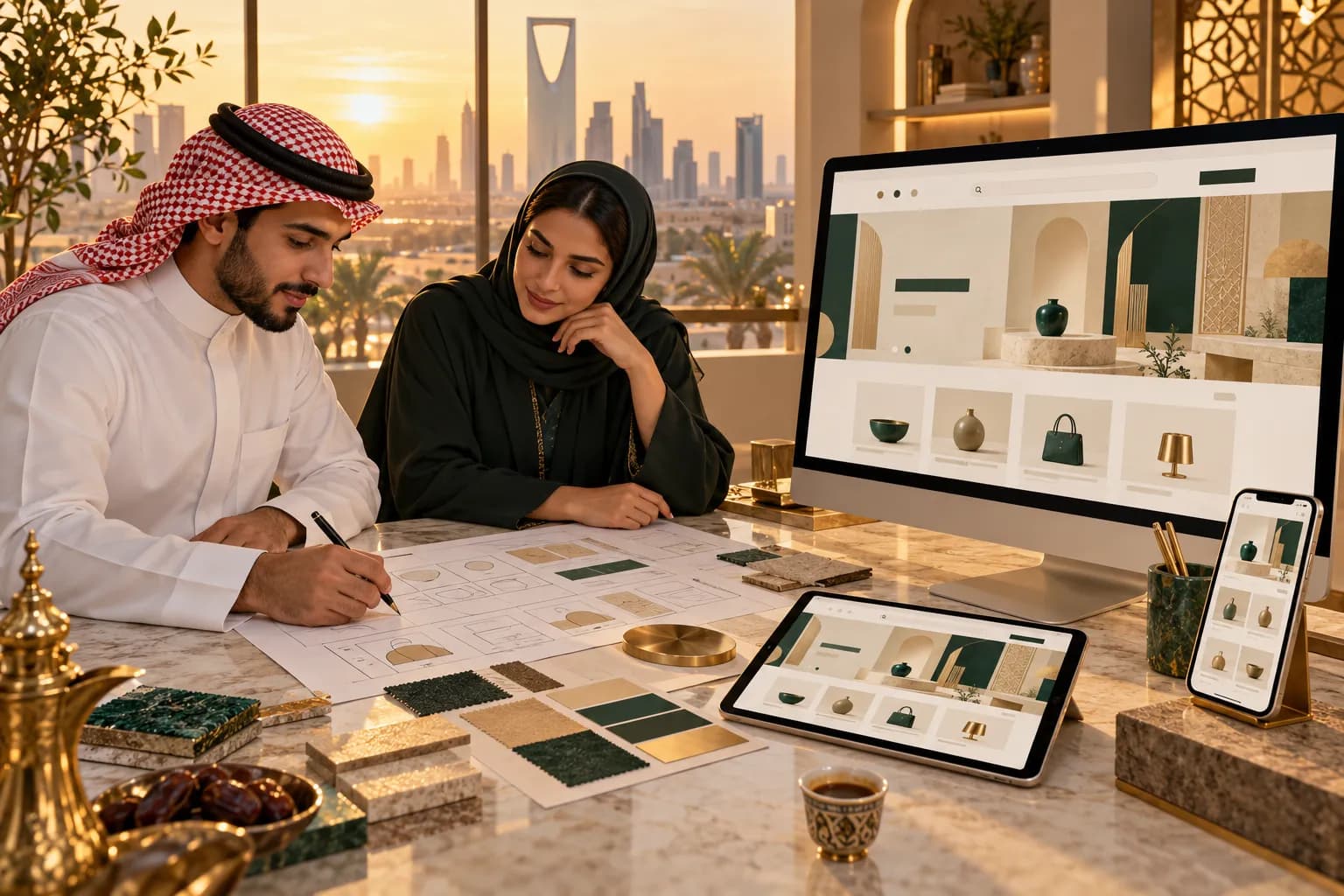

- An Arabic-first build designs the store in Arabic from the first wireframe, then adapts it into English. Nothing is translated as an afterthought.
- It's for new stores and full rebuilds. If your Shopify store already runs well in English, our localization service is the better fit.
- Every build covers RTL design, Arabic typography, Gulf Arabic copy, a fully translated checkout, local payments and pricing, and Arabic SEO.
- Each Gulf market, from Saudi Arabia and the UAE to Kuwait, gets its own language default, currency and payment setup inside one Shopify store.
- You own the store, theme and content from day one. We hand it over with training and a written operations guide.
Most Arabic Shopify stores are English stores wearing Arabic. The layout was built for short English words, then Arabic was poured in later.
Gulf shoppers can tell. Headlines wrap badly, menus use odd words and the checkout drops back into English.
An Arabic-first store starts the other way round. We plan, write and design it in Arabic, then adapt it into English.
That's what we build: new Shopify stores for Saudi Arabia, the UAE and the wider Gulf that feel made here, in both languages, from the first order.
Who is an Arabic-first Shopify build for?
It's for brands starting a new Shopify store, or rebuilding one from scratch, with Arabic-speaking shoppers as the main audience. It suits:
- Gulf brands going online. You sell in a shop, on Instagram or on a marketplace, and want your own store that reads like a Saudi or Emirati brand wrote it.
- Brands leaving Salla or Zid. You're used to an Arabic-native platform and want Shopify without losing that feel.
- International brands entering the Gulf. You'd rather launch a store built for Arabic shoppers than translate your home store and hope.
- Stores beyond repair. The current Arabic side is so patched that starting again is cleaner than fixing it.
Already have a Shopify store that works well in English? Our Shopify localization service adds Arabic to it without a rebuild.
What does "Arabic-first" actually change?
Arabic sets the rules for design, copy and structure. English is adapted from it, not the reverse.
That changes real decisions in the build:
| Arabic-first build | English build, translated later | |
|---|---|---|
| Where design starts | Arabic wireframes, right to left | English mock-ups, flipped afterwards |
| Headline and button sizes | Set for Arabic text length | Arabic squeezed into English space |
| Menu and collection names | Chosen from Arabic search terms | Translated from English labels |
| Copy | Written in Arabic first | Translated from English |
| Checkout and emails | Arabic ready before launch | Often left partly English |
| Arabic SEO | Planned with the site structure | Added once the store is live |
| Testing | Arabic first, on real phones | English first, Arabic spot checks |
For example, a hero banner often needs a different line break in Arabic. Designed in Arabic, it fits from day one. Designed in English, someone ends up shrinking the font.
What's included in an Arabic Shopify build?
Every build covers seven areas. We scope each one to your catalogue and markets.
1. Arabic UX and right-to-left design
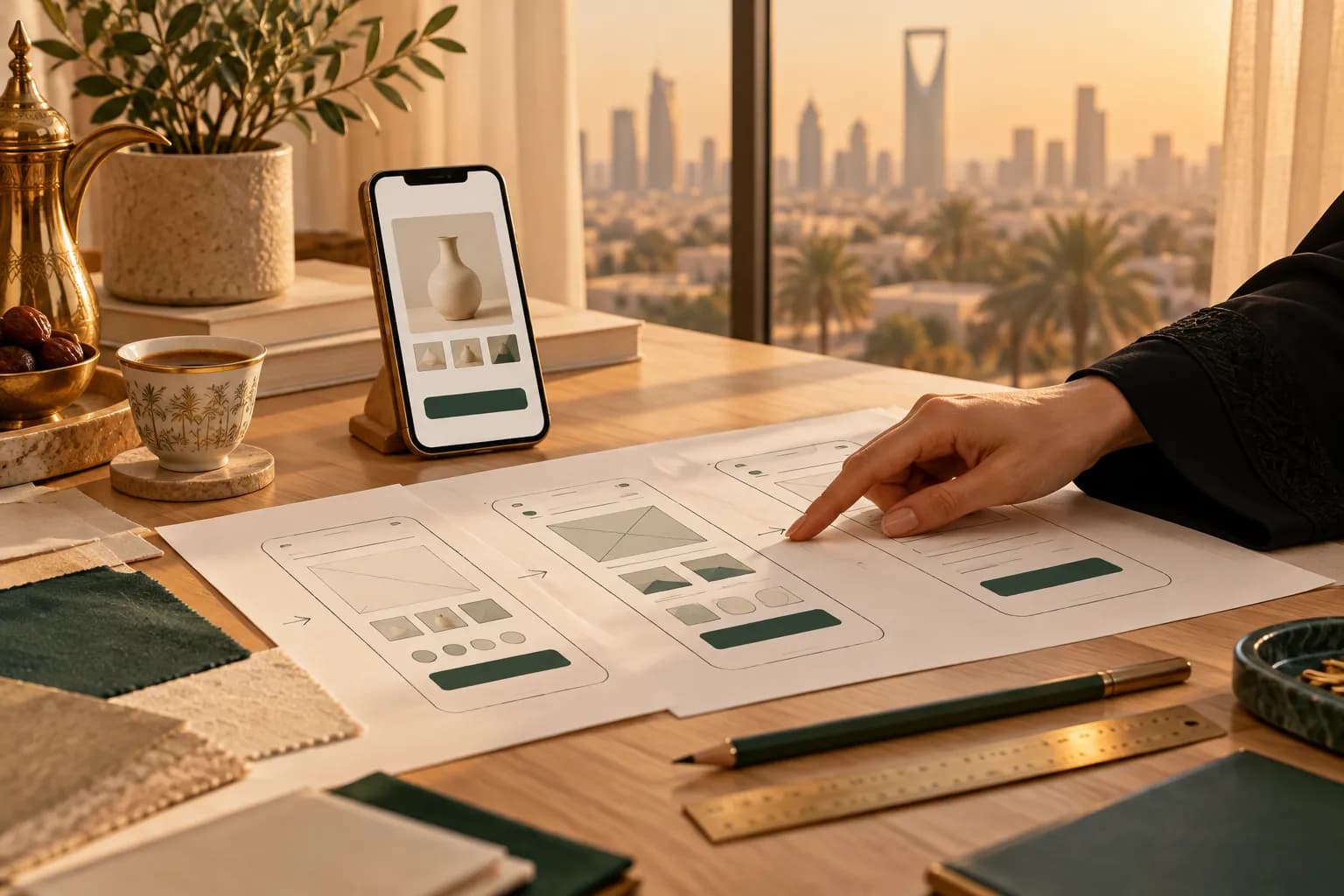
We design your key pages in Arabic first: home, collection, product, cart and the mobile menu.
- Mirrored the right way. Menus, filters, arrows and the cart drawer flip. Logos, product photos and media controls don't.
- Designed for the thumb. Mobile layouts come first, because that's where Gulf shoppers browse.
- Room for Arabic. Buttons, badges and banners sized for Arabic text, with English fitted into the same layout.
The rules we follow are in our RTL design guide.
2. Theme setup and Arabic typography
Since 2 October 2026, Shopify's checkout, customer accounts and Horizon themes lay out right to left on their own. So we start from a Horizon-family theme or a paid theme with native RTL support, then customise it for your brand.
Layout is only half the job. Typography gets its own pass:
- An Arabic font that suits your brand and reads well on small screens.
- No letter-spacing on Arabic text, and enough line height for the dots and marks above letters.
- Western digits, not Arabic-Indic ones, for prices, sizes and order numbers.
- Two or three font weights, so the Arabic pages stay fast.
Comparing themes yourself? See our Arabic Shopify themes shortlist and the Arabic web fonts guide.
3. Arabic copy and store structure
Words come before the final design, so the layout fits them. We write:
- Navigation and collection names based on the Arabic terms shoppers actually search.
- Homepage, banners and buttons in a Saudi, Emirati or general Gulf tone.
- Product titles and descriptions in clear, modern Arabic, starting with your best sellers.
- Policies and FAQs in plain Arabic that shoppers can trust before they pay.
Native speakers write the pages that sell. Long-tail descriptions get a machine draft plus a native edit. Our Arabic product descriptions guide shows the template.
4. Arabic checkout, notifications and apps
Arabic isn't one of the 33 checkout languages Shopify pre-translates. Any string left empty shows in English, right when the shopper is about to pay.
So we translate every checkout button, field label and error message. Then order confirmations, shipping updates, refund emails and SMS. The method is in our Arabic checkout translation guide.
Apps need the same care. Reviews, upsells, COD forms, chat widgets and BNPL banners carry their own text. We pick apps with Arabic support during the plan, then check each one in Arabic.
5. Payments, prices and delivery per market
Each Gulf market gets its own setup inside one store, through Shopify Markets:
- Prices in SAR, AED or KWD, with VAT shown the way local rules expect.
- Payment labels shoppers recognise in Arabic, such as مدى for mada and الدفع عند الاستلام for cash on delivery.
- Address and phone fields in the local format, including the Saudi National Address.
- Delivery messages with realistic times per city.
Gateway and courier setup goes deeper when one country leads. That's where our Saudi and Dubai builds come in.
6. Arabic SEO from launch day
Arabic search is its own market, and a store planned around Arabic keywords is ready for it on launch day.
We set up Arabic and English subfolders per market, such as /ar-sa/ and /en-ae/, with hreflang so Google shows each shopper the right version. Every key page gets an Arabic title, description and image alt text. The method is in our bilingual SEO guide.
7. Arabic QA and handover
Before launch, we walk the full order journey in Arabic on a real iPhone and Android phone, including social in-app browsers. We place test orders on every payment method, then fix what we find.
How does an Arabic Shopify project work?
Five steps, from first call to a store that's taking orders. How long each takes depends on scope and on how fast your payment and courier accounts are approved.
- 1
Discovery
A call about what you sell, which Gulf markets you're targeting, who your shoppers are and which language should lead in each market. We confirm Shopify is the right fit.
- 2
Plan
Arabic keyword research for your categories, a site structure, Arabic wireframes for key pages and a written scope with a quote broken down by deliverable. Nothing starts until you approve it.
- 3
Build
Arabic copy first, then design, theme, checkout, payments, pricing, delivery and SEO. English is adapted alongside. Gateway and courier applications start early, because nobody can rush them. You review both languages on a preview link.
- 4
Launch
Full Arabic and English QA on real phones, test orders on every payment method, fixes, then we publish together.
- 5
Support
We fix anything that comes up after launch, help with the first orders and train your team to add products and campaigns in both languages.
What you get at handover
When the store goes live, everything is in your name. You'll have:
- A live Arabic and English store, tested on iPhone and Android.
- An Arabic style guide with your tone, glossary and words to avoid, so new copy stays consistent.
- A short operations guide for orders, products, discounts and translations.
- A list of every app we installed, what it does and its monthly cost.
Why does Arabic-first pay off in the Gulf?
Gulf ecommerce is growing fast, and Arabic-speaking shoppers are its core. A store that speaks to them first earns trust a translated store has to work for.
Saudi shoppers buy in Arabic
Saudi Arabia is the Gulf's largest ecommerce market, and it's Arabic-first. Saudis expect a store to read naturally in their language, from the banner to the delivery SMS.
A translated store gets the words roughly right. An Arabic-first store gets the tone right too, and tone is what makes a new brand feel trustworthy. Our guide to Saudi product pages shows what shoppers look for.
The UAE expects Arabic, even when English leads
Plenty of UAE shoppers browse in English. But UAE-registered online sellers must give product information in Arabic, so a full Arabic store isn't optional there.
Shopify Markets lets English lead in the UAE while Arabic leads in Saudi Arabia, all in one store. See our Arabic vs English in the UAE guide for how to split the two.
Shoppers arrive on a phone, often from Snapchat
About 73% of people in Saudi Arabia can be reached on Snapchat. A tap on an ad opens your store inside the app's own browser, on a small screen, in Arabic.
That's why every Arabic page is designed for mobile first and tested inside those browsers. Our mobile commerce guide covers what converts on a phone.
Which of our Shopify services do you need?
Our Shopify services overlap on purpose. Here's how to choose:
| Best when | Main focus | |
|---|---|---|
| Arabic Shopify development | You're building a new store, or starting over, with Arabic shoppers at the centre | Arabic-first design, copy and SEO across the GCC |
| Shopify localization | Your Shopify store already works in English | Adding natural Arabic, checkout and local pricing without a rebuild |
| Shopify redesign | Your store runs but converts poorly | Better mobile pages, keeping your URLs, products and customers |
| Shopify development in Saudi Arabia | Saudi Arabia is your main market | Saudi gateway, mada, COD, couriers and ZATCA-ready invoicing |
| Shopify development in Dubai | The UAE is your main market | Shopify Payments, Tabby and Tamara, UAE couriers and licence details |
Many projects combine two. An Arabic-first build for the Saudi market, for example, includes the Saudi payment and delivery setup from our Shopify development in Saudi Arabia service. A tired store that only needs better pages is a job for our Shopify redesign service.
What will you need to provide?
We handle the build. A few things only you can supply:
- A Shopify account in your name, so you own the store from day one.
- Your markets. Which Gulf countries you'll sell in at launch, and which come later.
- Product data. Names, prices, variants, weights and stock, ideally in a spreadsheet.
- Photos and brand assets. Product images, logo, colours and any brand guidelines.
- Brand voice notes. How formal or playful you sound in each language, and any words you never use.
- Business documents. Your commercial registration or trade licence and bank details, for payment and courier sign-ups.
- One decision-maker who can approve copy and designs quickly.
Moving from Salla or Zid? Bring your admin access too. Our Salla to Shopify migration service plans the move of products and Arabic URLs.
Is an Arabic-first build right for you?
Tick the boxes that describe you. If most of them fit, an Arabic-first build is likely a good match.
If your store already sells well and only the Arabic is missing, a rebuild is more than you need. Shopify localization is the lighter option, and we'll say so on the call.
Start your Arabic Shopify project
Tell us what you sell, which Gulf markets you're aiming for and what you already have. We'll get back to you to set up a short discovery call.
Frequently asked questions
Mostly simple Modern Standard Arabic, which every Gulf shopper reads comfortably and which works for search. Banners, social-style headlines and a few buttons can carry a light Saudi or Emirati tone. We agree the mix in your style guide, so new copy sounds the same a year from now.
Sources & further reading
- Requirements for selling in multiple languages — Shopify Help Center
- Translating your checkout — Shopify Help Center
- Admin now available in 3 new languages (RTL support) — Shopify Changelog, 2 Oct 2026
- Can't Read, Won't Buy B2C — CSA Research
- E-commerce (licensing to sell online) — UAE Government portal (u.ae)
- Digital 2026: Saudi Arabia — DataReportal
- Desktop vs mobile market share, Saudi Arabia — StatCounter, Sep 2026
- Arabic & Persian Layout Requirements — W3C
This guide is for general information only and is not legal, tax or financial advice. Rules and fees change — always confirm with the official source or a licensed advisor.

Maya is MiddleEastEcom's lead guide and editor. She researches GCC marketplaces, payments and regulations and turns them into practical playbooks for sellers.
Meet Maya