

- We redesign live Shopify stores selling in Saudi Arabia, the UAE and the wider Gulf, with more sales as the goal, not just a new look.
- Every project starts with an audit of your analytics, checkout and phone experience, so the work fixes the biggest leaks first.
- Checkout gets the Gulf basics: mada and Apple Pay up front, Tabby or Tamara on the product page, and cash on delivery with guardrails.
- We protect your SEO with a URL map and redirects, and build on an unpublished theme while your store keeps selling.
Your Shopify store already has traffic. The question is how many of those visitors buy.
In the Gulf, most of them arrive on a phone, often from Snapchat or TikTok, and often reading in Arabic. A store designed for desktop shoppers in London or New York doesn't always win them over.
The good news? You don't need to start again. A focused redesign of the pages that sell can turn more of the same ad spend into orders.
That's what we do. We redesign existing Shopify stores for Saudi and UAE shoppers, starting from your data.
Who is this service for?
It's for brands that already sell on Shopify in the Gulf and know their store could convert better. You keep your products, customers, apps and URLs. We change how the store looks and works.
Signs it's time for a redesign:
- Traffic without sales. Ads bring visitors, but too few add to cart or finish checkout.
- A weak phone experience. Mobile converts at well under half your desktop rate, or the price and "Add to cart" button sit several scrolls down.
- A store built for another market. The design worked in Europe or the US, but Gulf shoppers bounce.
- Years of patches. Apps, banners and custom code have made the theme slow and messy.
- Arabic as an afterthought. Your Arabic pages look like English pages flipped in a mirror.
Why does a Gulf redesign need local know-how?
Gulf shoppers want what shoppers want anywhere: a clear product, a fair price and a safe checkout. What changes is how they judge each one.
A generic redesign usually misses three things:
- Phones and social traffic come first. Many visits start inside Snapchat, TikTok or Instagram, and desktop converts at up to twice the mobile rate in the region (RATH, 2026). That gap is where most redesign gains come from. See our mobile commerce guide.
- Trust decides the first order. A new shopper in Riyadh wants proof you're a real store: local payment badges, a WhatsApp number, a clear returns line and Arabic reviews. Our trust signals guide lists what to show.
- Arabic needs its own layout. Right-to-left reading changes the whole page, not just the text direction. Our RTL design guide shows what should mirror and what shouldn't.
What's included in a Shopify redesign?
Every project covers six areas. We scope each one after the audit, so the work goes where your store loses the most sales.
1. Conversion audit
Before we design anything, we find out where shoppers drop off. We look at:
- Your analytics, split by device, market, language and traffic source.
- The funnel: product views, add to cart, checkout started, orders paid.
- Payment data: failed payments, COD share and refused parcels.
- A phone walkthrough in Arabic and English, on an iPhone and a mid-range Android.
You get a written list of problems, ranked by how many sales each one likely costs. That list becomes the design plan.
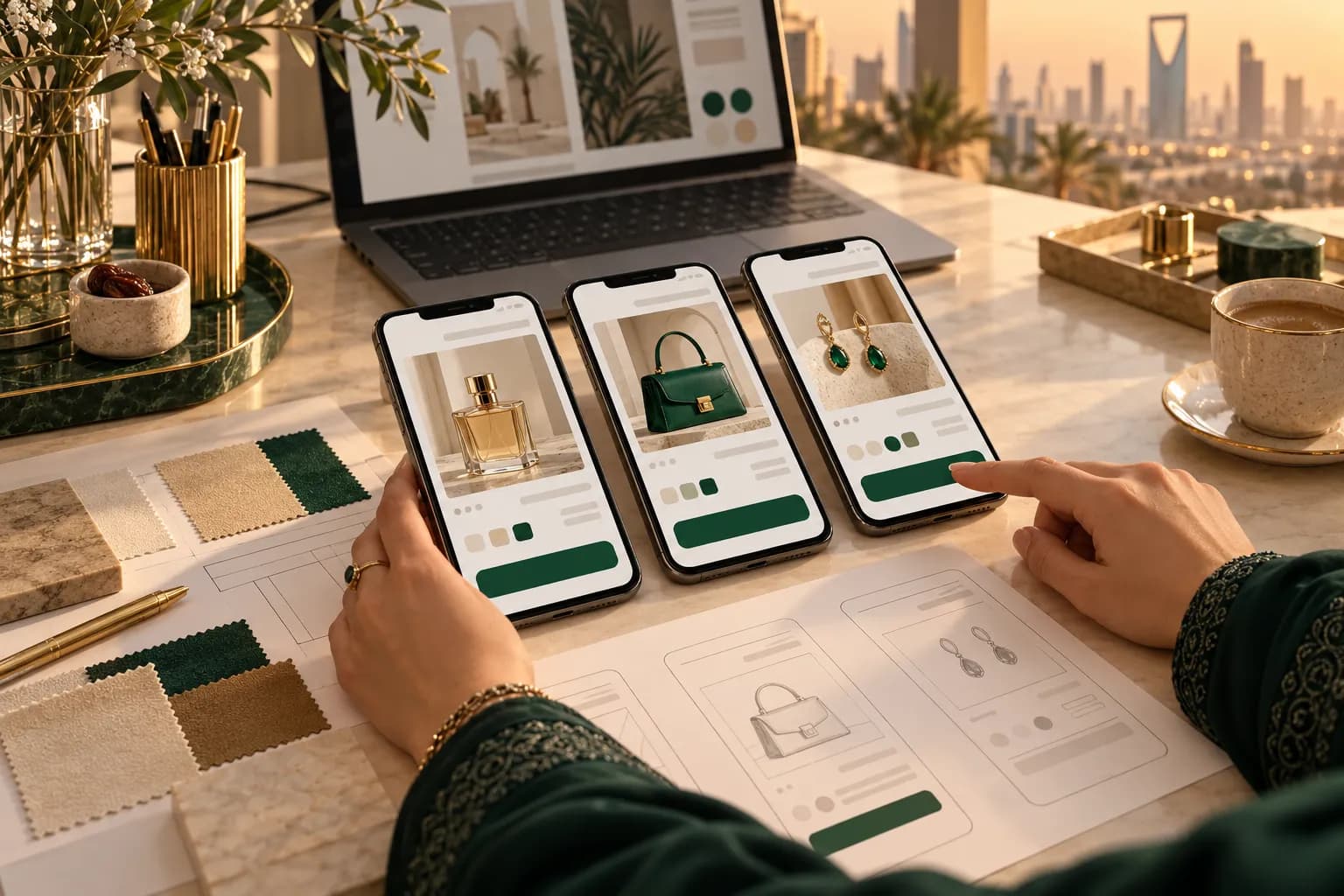
2. Mobile-first page design
We design every key template for the phone first, then adapt it for desktop:
- Homepage: best sellers, the current offer and your delivery promise on the first screen.
- Collection pages: fast filters, clear prices and sizes, and quick add to cart.
- Product pages: price, instalments, delivery date and "Add to cart" visible without scrolling, plus a sticky buy button.
- Landing pages for social ads: short, video-led pages that match the ad the shopper just tapped.
3. Checkout and Gulf payment methods
Checkout is where small fixes pay off fastest. We set it up for the way Gulf shoppers pay:
- mada and Apple Pay first for Saudi shoppers, with cards below.
- Tabby or Tamara shown on the product page with the instalment amount, not only at checkout.
- Cash on delivery with guardrails, such as order caps and WhatsApp confirmation before dispatch.
- No surprise costs. VAT-inclusive prices and delivery fees shown before checkout.
- Phone-first forms with guest checkout.
WhatsApp confirmation before dispatch cuts COD returns by 10–15 points for many UAE stores (Quiqup, 2026). Our guide to Shopify COD apps covers the tools, and Tabby vs Tamara helps you pick a BNPL provider.
4. Trust and Arabic layout
We place proof where the shopper needs it, not in the footer: payment badges near the price, a delivery promise by city, a one-line returns summary, reviews with photos and a WhatsApp button on a local number.
The Arabic version gets its own design pass, with mirrored menus and sliders, Arabic fonts that read well on phones, and Western digits for prices. Our Arabic fonts guide compares the options. Translating the copy itself is part of our Shopify localization service.
5. Speed and app clean-up
Gulf mobile networks are fast, so a slow Shopify store is almost always slowed by the store itself. The usual culprits are heavy apps, tracking scripts, oversized images and Arabic font files.
We review every app and remove the ones that don't earn their keep. Then we compress images, trim scripts and check Core Web Vitals, Google's speed and stability measures, before and after.
6. SEO-safe launch and QA
A redesign shouldn't cost you the rankings you've earned. We keep your URLs where we can, redirect any that change, and keep hreflang tags and structured data in place.
Then we walk every key journey on real phones in both languages and place test orders on each payment method. The full test list is in our RTL QA checklist.
Refresh your theme or move to a new one?
The audit decides this. Here's how we weigh it:
| Refresh current theme | Move to a new theme | |
|---|---|---|
| Best when | The theme is fast and well built, just poorly laid out | The theme is slow, heavily patched or outdated |
| Right-to-left support | Already works, or needs small fixes | Missing or broken; Horizon-family themes support it natively |
| Effort | Lower | Higher |
| Risk to apps and custom code | Low | Each app needs checking on the new theme |
| Design freedom | Limited by the existing theme | Full |
| Speed gains | Moderate | Usually larger |
Since Shopify's October 2026 update, Horizon-family themes lay out right to left on their own. That makes a move cheaper than it used to be for stores with weak Arabic support. Our Arabic Shopify themes guide compares the options.
How does a redesign project work?
Five steps, from first call to a live store. How long each takes depends on how many templates change and whether you keep your theme.
- 1
Discovery
A call about your store, your markets and your goals. We get collaborator access and agree the numbers that define success.
- 2
Plan
We run the conversion audit and send a written plan: what to change, in what order, and a quote split by deliverable. Nothing starts until you approve it.
- 3
Build
We design the key templates for mobile first, review them with you, then build on an unpublished theme while your store keeps selling.
- 4
Launch
We run QA on real phones in Arabic and English, place test orders, set redirects and publish at a quiet time you choose.
- 5
Support
We fix anything that comes up after launch, compare the numbers against your baseline and suggest the next round of tests.
What you get at handover
When the new design goes live, you'll have:
- A redesigned live store, tested on iPhone and Android in both languages.
- The audit report, with each problem found and what we changed.
- A before-and-after baseline for the numbers agreed in discovery.
- A URL and redirect map, so your SEO history stays intact.
- A short editing guide so your team can update banners and landing pages without breaking the design.
- A test backlog: ideas worth A/B testing next, in priority order.
Notes for Saudi stores
Saudi Arabia is Arabic-first and mobile-heavy, so the Arabic phone layout gets the most attention. English becomes the adaptation, not the other way round.
We also make the Short Address field easy to find in checkout. Couriers can return parcels without a valid National Address, as our National Address guide explains. For a sense of what good looks like, see our Saudi conversion rate benchmarks.
Notes for UAE stores
The UAE is more English-first, and about four in ten visits still come from a computer. So English is usually the default, with a full Arabic version one tap away, and the desktop layout has to sell too.
Address forms get building and landmark fields, because many UAE addresses rely on them. For regional benchmarks, see our GCC conversion rates guide.
What will you need to provide?
We handle the redesign. A few things only you can supply:
- Collaborator access to Shopify, so you stay in control of your account.
- Analytics access, such as Google Analytics, Shopify reports and your ad platforms.
- Brand assets: logo files, colours, fonts and any guidelines.
- Product photos and videos, ideally including short vertical clips for social traffic.
- The questions your team hears most often on WhatsApp or by phone.
- One decision-maker who can approve designs quickly.
Is this service right for you?
If most of these fit, a done-for-you redesign is likely a good match.
If your store is brand new with little traffic, a full redesign may be too early. Start with our Arabic Shopify guide, and come back once you have data to work from.
Start your redesign
Tell us about your store, your markets and what's not working. We'll get back to you to set up a short discovery call.
Looking for something else? Browse all our services for Gulf sellers.
Frequently asked questions
It depends on how many templates change, whether you keep your theme, and how many languages and markets you sell in. After the audit we send a written quote split by deliverable. Many stores start with the product page and checkout, then redesign the rest in a second phase.
Sources & further reading
- Desktop vs mobile vs tablet market share, Saudi Arabia and UAE — StatCounter, Sep 2026
- Ecommerce in Saudi Arabia and the UAE: funnel sample data — ECDB, 2025
- Average ecommerce conversion rate: UAE benchmarks 2026 — RATH Infotech, 2026
- 4th annual MENA report: cash on delivery usage halved — Checkout.com
- Rules regulating BNPL companies — Saudi Central Bank (SAMA), Dec 2025
- How to reduce RTO rate in UAE ecommerce — Quiqup, 2026
- Web Vitals — Google web.dev
This guide is for general information only and is not legal, tax or financial advice. Rules and fees change — always confirm with the official source or a licensed advisor.

Maya is MiddleEastEcom's lead guide and editor. She researches GCC marketplaces, payments and regulations and turns them into practical playbooks for sellers.
Meet Maya